Lagos · pay per sale
Buy real customers,
not impressions or clicks.
Set a price on a real sale. Pay it only when one happens.
About ten minutes to set up, once your street opens.
Pairs we match
You already know this idea from online shopping: frequently bought together. We do it across shops instead of inside one basket. People buy in trips, not one errand at a time, so we work out whose customers already overlap with yours: the drinks shop beside the suya spot, the hair products store beside the barber. Then your offer goes on their counter, in front of someone who is already out and already spending. Never on a competitor's. That is a rule inside the matching, not a setting you have to remember.

₦0
Until a sale is verified. There is no listing fee and no monthly fee.
7
Days a reward is held after a sale, so refunds and returns settle first.
1
Carrier per code, per offer. Never a shop that competes with them.
For shops funding an offer
Set what a first-time customer is worth to you, fund it, and watch exactly what the money bought.
For people carrying a code
Pick an offer from a shop near you, share your own QR code, and see each sale land with its full record.
For shops with a counter
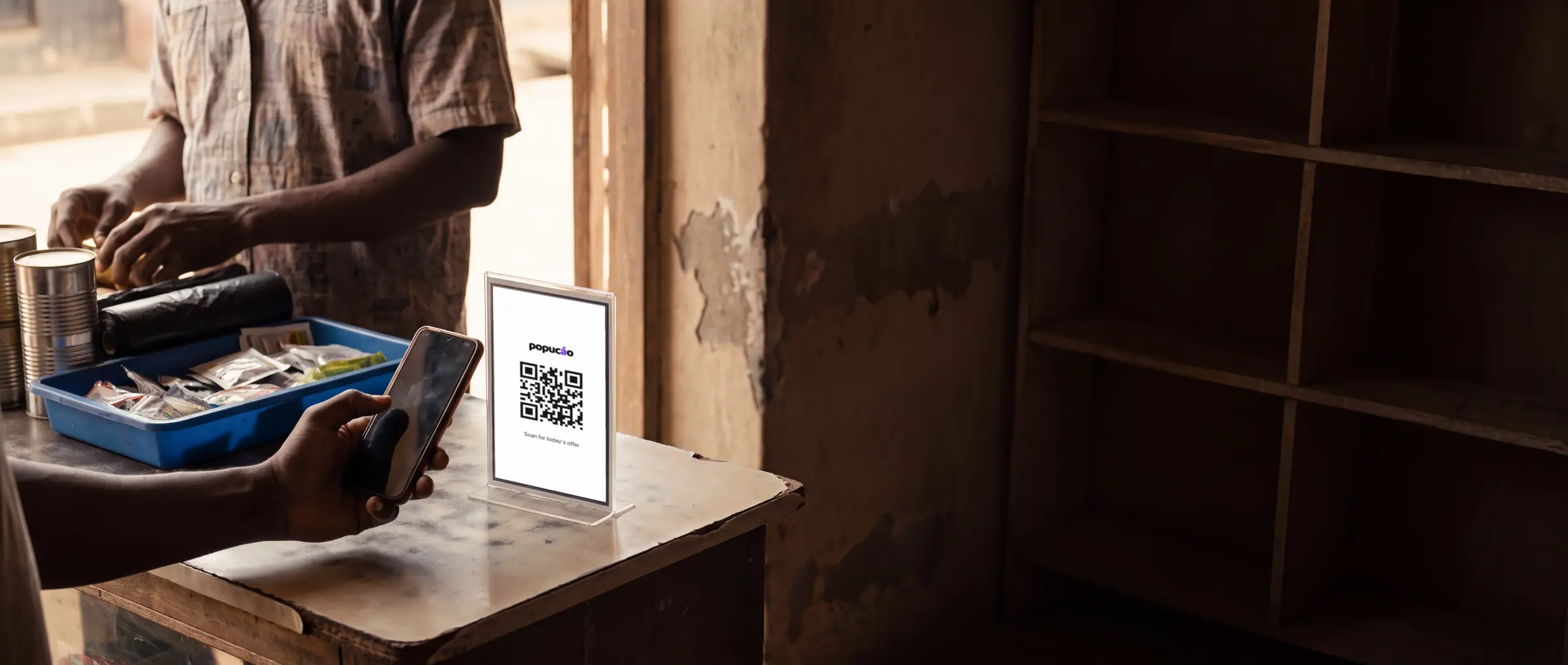
Stand a partner shop's card on your counter. It costs nothing and competes with nothing you sell.
No hardware, no installation, nothing to learn. You can be running an offer before the shop closes today.
One code, tied to one carrier and one offer. Every sale it produces is traceable back to it, which is what makes the reward arguable rather than a matter of trust.
A5, black and white, prints on any machine in any business centre. Stand it beside your till and it works. Nothing on it expires.
Every sale dated, referenced and reconciled, including the ones that earned nothing. Export it, print it, take it to a dispute.
We find the shop whose customers already overlap with yours and put your offer on their counter. You do not have to know who they are.
A discount for the customer, plus a reward for whoever brings them in. The budget is a cap, not a deposit. You are only billed for sales we verify.
Each carrier gets their own QR code. One code, one carrier, one offer, and never an offer from a shop that competes with them.
No app, no login. They see the discount in seconds and pay the shop the way that shop already takes money. Popucáo is not in the middle of it.
The sale ties back to the exact code, we verify the customer is genuinely new, and the reward splits automatically.
An impression
A screen somewhere showed your advert. You paid for that. Nobody can tell you whether the person looked at it.
A click
Someone tapped it. You paid for that too. Most of them left before the page finished loading, and none of them walked into your shop.
A verified sale
Someone came in and bought something. This is the only one of the three you can count at the end of the day, and it is the only one we charge for.
Decide the discount the customer gets and the reward the carrier earns.
| To the carrier | ₦500 |
|---|---|
| To Popucáo | ₦214 |
| You pay, per sale | ₦714 |
Every sale is dated, referenced and reconciled, including the ones that earned nothing. That is the point.
A reward is recorded the moment a sale is verified, then held for 7 days in case the customer returns the item or disputes the payment. After that it is yours to withdraw.

Pick an offer from a shop near you and pass your code to the people you would have told anyway. The money comes from the sale itself: someone buys with your code, you earn, and nothing is ever paid for signing a person up.
There is no payment for signing anyone up.
There is no downline, no team, and no bonus for bringing another person onto Popucáo. Not in the app, not in the terms. Rewards exist for sales, and only for sales. You get paid when someone buys using your code.
We also never pair a carrier with a business that competes with them.
A brown one is forgettable. A purple one stops you cold. Our job is to make an ordinary shop the one people notice, and to hold advertising itself to the same test: measurable, honest, and paid for only when it works.
Coming soon
We are designing screens that carry the same matched offers: shop counters, building lifts, waiting halls, and the junction above the traffic. None of it exists today, and nothing else on this page depends on it. When it does exist, the rule will not change. The shop still pays only for a verified sale.


Matching only works where the shops are close enough to share customers, so we are starting in one place and doing it properly rather than thinly everywhere. If you are outside the first area, say so and you go on the list for yours.
Everything after Yaba depends on how many shops on one street sign up, not on a date we picked.
Matching needs neighbours, so we open streets rather than cities. Leave your number and we will tell you when yours is next. No newsletter, no updates you did not ask for, one message when it is your turn.
We check the customer's number against that shop's past sales through Popucáo. If they have bought there before, they still get their discount. The carrier just does not earn on it, and the ledger says so plainly.
No. They scan, the discount opens in their browser, and they pay the shop directly: cash, transfer, card, whatever that shop accepts. Carriers and shops work entirely in a browser. Customers never install anything.
Rewards are held for 7 days after the sale, then become available to withdraw to a bank account in your own name. Withdrawals are free, with a ₦1,000 minimum.
No. Nobody is paid for signing anyone up, and there is no downline. Rewards are paid for verified sales only.
The reward is returned with it, and the reason appears on the carrier's ledger. If they think that is wrong, they can appeal and a person reviews it.
Pay it only when one walks in.
No password to forget. We send you a one-time code, you type it, you are in.